
 EN
EN IT
IT DE
DE FR
FR ES
ESOEM industrial machinery manufacturers are facing increasing pressure on production costs.
The rise in metal, energy, and logistics prices is making the replacement of aluminum components with technical plastic materials—especially polycarbonate—an increasingly strategic choice.
Today, the machining of technical plastics represents a concrete solution for the outsourced production of components based on drawings, enabling cost reduction, lighter machines, and improved competitiveness of the final product.

Current scenario: rising costs of metals, energy, and transportation
In recent years, the machinery manufacturing sector has experienced strong fluctuations in industrial costs:
🟠 high volatility in aluminum and metal prices
🟠 increased energy costs in mechanical processes
🟠 rising international transport and logistics costs
🟠 longer procurement lead times
For OEMs, this means reduced margins and greater difficulty in maintaining competitive pricing.
In this context, replacing aluminum with polycarbonate is becoming a real lever for cost reduction.
Why replace aluminum with polycarbonate
Raw material cost reduction
🟢 Polycarbonate has a more stable and generally lower cost than aluminum, which is heavily influenced by energy and geopolitics.
This allows for greater predictability in production costs.
Reduced transport and logistics costs
Polycarbonate is up to 50% lighter than aluminum:
🟢 lower transport costs
🟢 lighter machines
🟢 greater international logistics efficiency
More stable supply chain
Engineering plastics enable:
🟢 faster lead times
🟢 greater production continuity
🟢 reduced dependence on metal markets
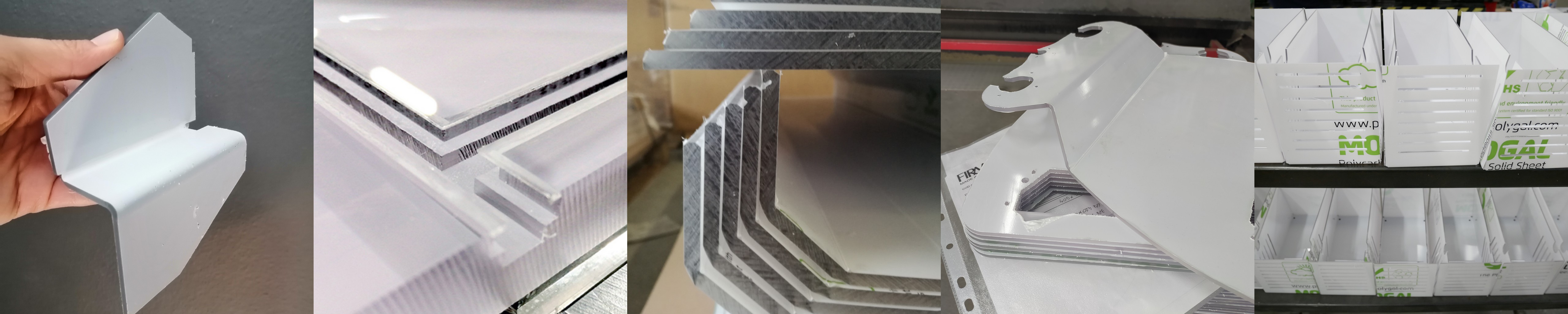
Machine components that can be converted to polycarbonate
Many components currently manufactured in aluminum can be redesigned in polycarbonate while maintaining high performance.
Typical OEM applications
- frames and lightweight structures
- enclosures and protections for automatic machines
- sensor supports and fastening systems
- technical panels and transparent covers
- components for automation lines
- parts for robotics and packaging
Polycarbonate frames instead of aluminum
Manufacturing frames in polycarbonate is one of the most frequent requests from technical departments.
Key advantages
- machine weight reduction
- high impact resistance
- elimination of oxidation and corrosion
- greater design freedom
- reduced serial production costs
Machining of engineering plastics for OEMs
We specialize in machining engineering plastics based on technical drawings for small and medium production batches.
⚙️ CNC milling of engineering plastics
Production of precision components with tight tolerances and complex geometries.
⚙️ Turning of plastic materials
Manufacturing of bushings, spacers, and cylindrical technical components.
⚙️ Laser cutting and engraving
Ideal for machine panels, technical markings, and clean machining.
⚙️ Knurling on plastic materials
Anti-slip surfaces for knobs and adjustment systems.
⚙️ Thermoforming on molds
Production of enclosures, covers, and 3D protections.
⚙️ Polishing and grinding
Aesthetic finishes, transparent surfaces, and high dimensional tolerances.
Reducing OEM machine industrialization costs
Converting from metal to engineering plastics makes it possible to:
✅ reduce the final machine cost
✅ accelerate industrialization
✅ improve design for manufacturing (DFM)
✅ increase OEM product competitiveness
In the current context of rising metal, energy, and transportation costs, replacing aluminum with polycarbonate represents a strategic choice for OEM industrial machinery manufacturers.
Cost reduction, lighter structures, and greater production efficiency are making engineering plastics increasingly central in industrial machine design.